


I live in Tucson, Arizona. For the last week, early June 2020, a wildfire has been raging in the Santa Catalina Mountains just north of the city. Tucson is surrounded by mountains, which makes it both beautiful and a wonderful place to go outdoors; hikes abound at all skill levels. The Catalinas are, to many including me, the iconic Tucson mountain range. They are close and they dominate the skyline. The “Foothills” of the Catalinas are the wealthy part of town, with often stunning views back down to the city and the other ranges, the Rincons to the east and the Santa Ritas to the south, and the Tucson Mountains to the west (which are also close in, but much smaller). The highest peak in the Catalinas, Mount Lemmon, at over 9000 feet, is accessible by car, and there is even a community, Summerhaven, near the peak. Some folks live there year-round but most have, well, a summer haven from the heat of the desert (highs in the 105 area this week). There is a wintertime downhill skiing area (one of only 3 in Arizona). There are many hiking trails, up there and on the road up. Sabino Canyon, leading into the mountains in the east, is a National Park, with a road (now limited to trams) up to the top, crossing the creek back and forth, from which trails spread out into the mountains, day hikes, backpacking, even up to the top if you’re fit and dedicated. My point is that the Catalina Mountains are part of the essence of Tucson, probably the natural feature most associated with our town.
 And
now they are burning. Less than a week ago, on a Friday night, we could see the
flames of the then-much-smaller fire, called the Bighorn Fire because it
started on Bighorn Mountain to the west of the view we see from the city. On
Saturday, a friend who lives in the northwest close to that area showed me
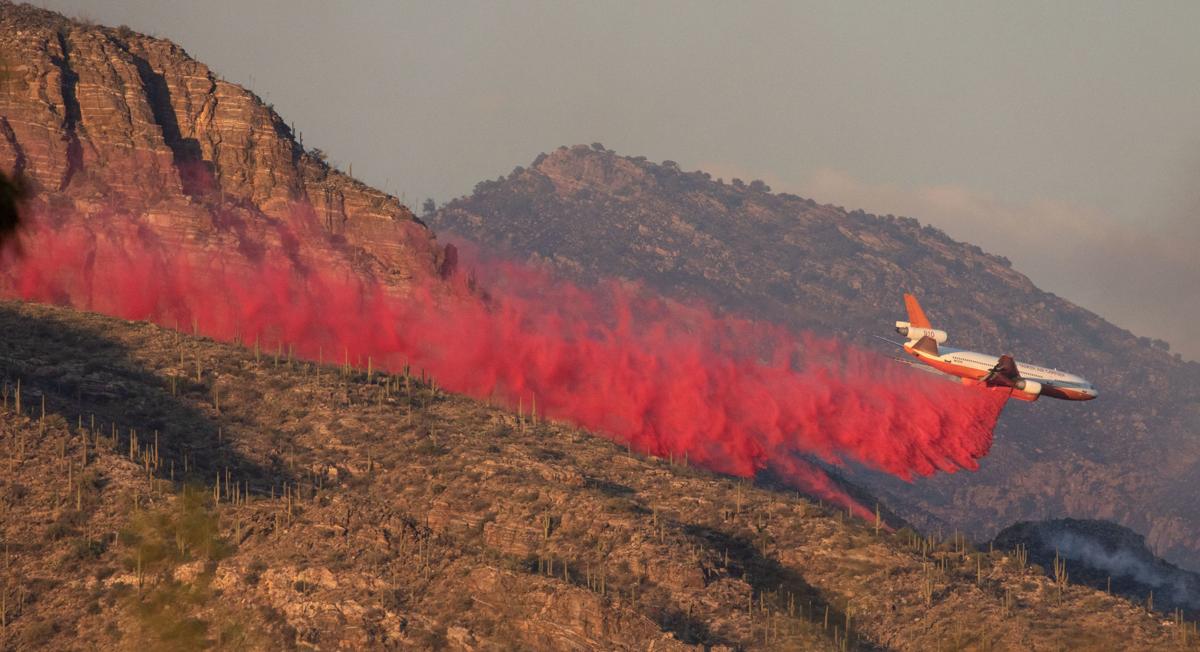
photos and videos of planes – smaller spotter planes and helicopters and huge
cargo planes -- piloted by brave pilot firefighters flying within 100 feet of
the mountains to drop orange fire retardant. Firefighters and hotshot teams
were brought in, but the fire continued to spread, from 200 to 2300 to now 3700
acres [update: passed 7,000 acres, 10% contained]. For a couple of days, planes could not fly, not because of weather but
because of a moron flying his own private drones in the area which endangered
them. Last night the flames of the original fire looked small as the blaze was
now visible across most of the front range, and this morning smoke covers it
all. More and more units are being brought in, but it appears as if, unless the
summer monsoon rains start soon – and there is no indication that they will –
the fire will continue to spread, including down into the canyons like Pima and
Finger Rock which are major hiking routes. And it will certainly threaten the
houses built up highest in the foothills. Those houses shouldn’t be there, they
should never have
been built as they are right up to the border of the National Forest (which,
fortunately, protects them from being built even higher); one of the more
galling hiking experience to Tucsonans for many years now has been that the
beautiful Pima Canyon hike begins with a half-mile trek between cyclone fences
through a private development. But although they should not be there, the
people who live in them should not have to lose their homes and possessions
(and of course, we most importantly hope, lives).
And
now they are burning. Less than a week ago, on a Friday night, we could see the
flames of the then-much-smaller fire, called the Bighorn Fire because it
started on Bighorn Mountain to the west of the view we see from the city. On
Saturday, a friend who lives in the northwest close to that area showed me
photos and videos of planes – smaller spotter planes and helicopters and huge
cargo planes -- piloted by brave pilot firefighters flying within 100 feet of
the mountains to drop orange fire retardant. Firefighters and hotshot teams
were brought in, but the fire continued to spread, from 200 to 2300 to now 3700
acres [update: passed 7,000 acres, 10% contained]. For a couple of days, planes could not fly, not because of weather but
because of a moron flying his own private drones in the area which endangered
them. Last night the flames of the original fire looked small as the blaze was
now visible across most of the front range, and this morning smoke covers it
all. More and more units are being brought in, but it appears as if, unless the
summer monsoon rains start soon – and there is no indication that they will –
the fire will continue to spread, including down into the canyons like Pima and
Finger Rock which are major hiking routes. And it will certainly threaten the
houses built up highest in the foothills. Those houses shouldn’t be there, they
should never have
been built as they are right up to the border of the National Forest (which,
fortunately, protects them from being built even higher); one of the more
galling hiking experience to Tucsonans for many years now has been that the
beautiful Pima Canyon hike begins with a half-mile trek between cyclone fences
through a private development. But although they should not be there, the
people who live in them should not have to lose their homes and possessions
(and of course, we most importantly hope, lives).
When I was in college at Cornell, more than 50 years ago, I was in a
dorm fire in which 9 people died. As we escaped that night, the smell of smoke
was everywhere, and when I came back to my room it had saturated everything. I
still smell that smoke; it was a toxic, petroleum based smoke from burning
naugahyde and smells much different from the lovely wood smoke of fireplaces in
the winter. But still, at bottom, smoke is smoke, and now as smoke fills the
air, threatening to make it more difficult to breathe while outside (and, of
course, in this COVID-19 epidemic, N-95 masks have not been available for
months, and if they are should go to health workers), the memories are getting
more and more vivid.
 There have been fires in the Catalinas before. Ten years
ago, much of Summerhaven was burned, and the ruined forest is still visible up
there. Firefighters have some hope that this fire will become limited as it
burns into that already-thinned area. Where the current fires are burning,
there has not been fire for a century, and fire is a natural part of the
natural cycle. The bighorn sheep on Bighorn Peak and Pusch Ridge that have been
re-introduced to supplement a dwindling herd will survive. They can escape the
flames. The mountains, eternal as they are, will survive, thinned out. The fire
was – this time – started by lightning, not people. But it is people who built
so close, and people who will suffer, and our trails will be closed, and the
beauty compromised.
There have been fires in the Catalinas before. Ten years
ago, much of Summerhaven was burned, and the ruined forest is still visible up
there. Firefighters have some hope that this fire will become limited as it
burns into that already-thinned area. Where the current fires are burning,
there has not been fire for a century, and fire is a natural part of the
natural cycle. The bighorn sheep on Bighorn Peak and Pusch Ridge that have been
re-introduced to supplement a dwindling herd will survive. They can escape the
flames. The mountains, eternal as they are, will survive, thinned out. The fire
was – this time – started by lightning, not people. But it is people who built
so close, and people who will suffer, and our trails will be closed, and the
beauty compromised.
And the smell of the smoke will linger.


