Tuesday, August 25, 2020

Valles Caldera and the National Park System

Valles Caldera National Preserve, abutting Bandelier National Monument to the north, was formed by the collapse of the “caldera” of an ancient volcano about 1.25 million years ago. Today it appears, magically out of nowhere as one drives up winding roads in the Jemez Mountains from Los Alamos, NM, winding through forests of Ponderosa pine at over 8000 feet, and then, on your right, an immense grassland without trees but with wooded hills dotted across it, lava domes created somewhat later. This is Valle Grande, the southern and most accessible part of the Preserve, which is much larger. One can access some of it on dirt roads, and requires a back-country permit. A mile from the entrance, reached by a road where ones car is improbably surrounded by bluebirds, making it seem as if you are driving through the introduction of a Disney cartoon movie, is the visitor’s center, today staffed by mask wearing Americorps volunteers as well as a ranger who were happy to provide information from a safe distance.

 
Our first stop was the restroom facilities, an outhouse that would not be worth mentioning if it were not for the fact that between the two doors, under the peak of the roof, was a bluebird nest with little fledglings looking out, waiting for their mother to return with lunch!


There are a few relatively short trails near the “front” that one can take dogs on. The closest, which we did, is called the La Jara trail, appropriate as it circles the Cerro La Jara, just west of the visitor center. It starts off through a large prairie dog village to the north of the cerro, and is dotted with wild (elk and coyote) and more domestic (cow and horse) scat. It is supposed to be 1.4 miles, but can be longer if one loses it (it is a trail marked through grassland by the traffic of hikers only, and it seems they have been fewer recently) and heads off instead on the track that goes north toward the Cabin District (old ranching cabins). At some point you decide that you have gone too far past the Cerro and need to make your way back and find the trail. This is easy to do as it is flat grassland. Well, it is easy to see where you need to go. In fact, the grass hides not only uneven ground but occasional marshes…

 The hike is not at all difficult, flat and short, but it is entirely open without shade and even at 8500 feet it is sunny. Especially when you take your mask off for the hike and it not only no longer protects your nose, but it has apparently rubbed off the sunscreen you so meticulously applied, something you notice on looking in a mirror on your return. And, of course, while we are pretty acclimatized to the altitude having spent a month already at nearly 7000 feet outside Santa Fe, that haze in the air is smoke from the Medio fire northeast of Santa Fe (and a new smaller one in the Jemez to the south, plus smoke blowing down from fires in Colorado) and does make breathing a bit tougher and riskier, so we’re glad we haven’t gone on one of the longer hikes.

I have realized that taking photos outside with one’s phone is a crapshoot, since any appreciable amount of sunlight makes it impossible to see what is on the screen. So my panoramic video of the Valle Grande is mostly sky. However, here are two pictures that capture a little of what the valle and cerros look like.


 I think it is also worth noting that, while having Americorps volunteers and young folks (meagerly) paid by a conservation foundation assisting the rangers is good, it is not as good as having enough rangers and enough resources to make the most of the magical lands that are the US National Park System. Our federal budget for the National Parks should be enormously increased. They should not have to depend upon increasing user fees (although these fees are suspended during the pandemic). They belong to all of us and their maintenance should be paid for by our taxes so that they can shine as the gems they are. Expecting them to be “self-supporting” or not “money losers” is not only absurd, it is an insane inversion of what our federal dollars should be paying for. Indeed, it is just as absurd as saying the US Postal Service is “losing money”! This is another area that, 180 degrees opposite from what the administration is doing, should have vastly enhanced support. And, of course, a third, less popular, federal agency that needs its budget hugely enhanced is the Internal Revenue Service, so it can ensure that billionaires and corporations do not continue to evade paying their taxes as they do now. I absolutely support laws increasing the taxes they should pay, but right now I would be satisfied with their paying the taxes legally due from them!

https://www.theguardian.com/world/2020/apr/15/tax-change-coronavirus-stimulus-act-millionaires-billionaires

https://finance.yahoo.com/news/corporations-paid-91-billion-less-in-taxes-in-2018-under-trumps-tax-law-160745447.html


Friday, June 12, 2020

Fire in the Santa Catalinas


I live in Tucson, Arizona. For the last week, early June 2020, a wildfire has been raging in the Santa Catalina Mountains just north of the city. Tucson is surrounded by mountains, which makes it both beautiful and a wonderful place to go outdoors; hikes abound at all skill levels. The Catalinas are, to many including me, the iconic Tucson mountain range. They are close and they dominate the skyline. The “Foothills” of the Catalinas are the wealthy part of town, with often stunning views back down to the city and the other ranges, the Rincons to the east and the Santa Ritas to the south, and the Tucson Mountains to the west (which are also close in, but much smaller). The highest peak in the Catalinas, Mount Lemmon, at over 9000 feet, is accessible by car, and there is even a community, Summerhaven, near the peak. Some folks live there year-round but most have, well, a summer haven from the heat of the desert (highs in the 105 area this week). There is a wintertime downhill skiing area (one of only 3 in Arizona). There are many hiking trails, up there and on the road up. Sabino Canyon, leading into the mountains in the east, is a National Park, with a road (now limited to trams) up to the top, crossing the creek back and forth, from which trails spread out into the mountains, day hikes, backpacking, even up to the top if you’re fit and dedicated. My point is that the Catalina Mountains are part of the essence of Tucson, probably the natural feature most associated with our town.

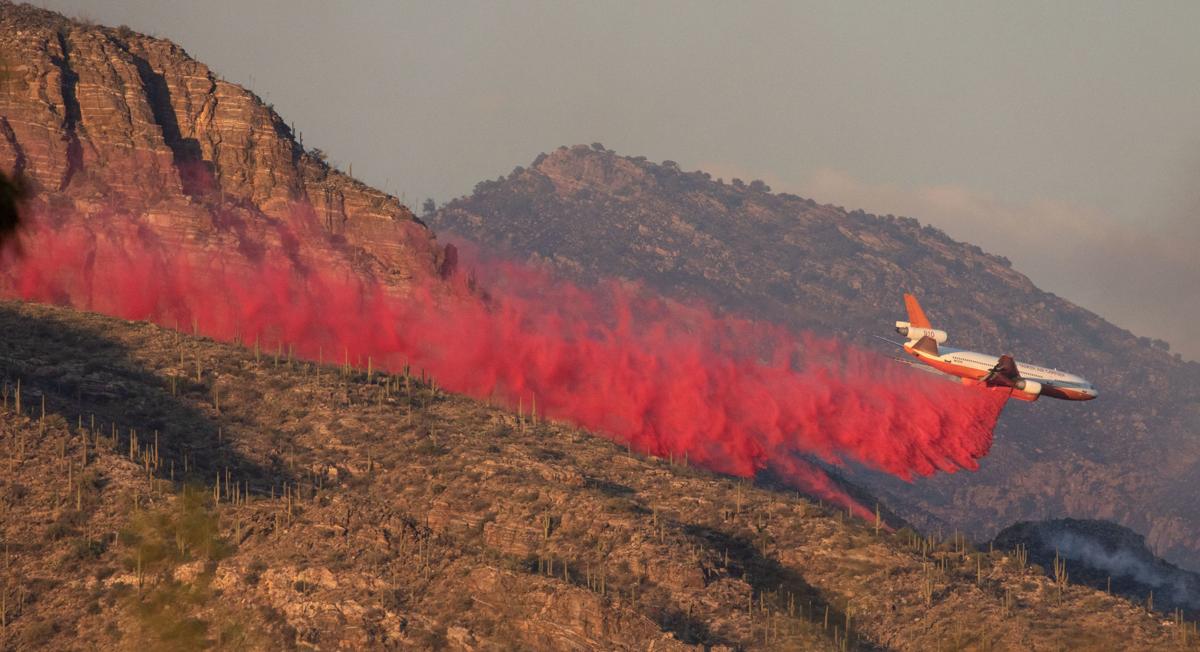
And now they are burning. Less than a week ago, on a Friday night, we could see the flames of the then-much-smaller fire, called the Bighorn Fire because it started on Bighorn Mountain to the west of the view we see from the city. On Saturday, a friend who lives in the northwest close to that area showed me photos and videos of planes – smaller spotter planes and helicopters and huge cargo planes -- piloted by brave pilot firefighters flying within 100 feet of the mountains to drop orange fire retardant. Firefighters and hotshot teams were brought in, but the fire continued to spread, from 200 to 2300 to now 3700 acres [update: passed 7,000 acres, 10% contained]. For a couple of days, planes could not fly, not because of weather but because of a moron flying his own private drones in the area which endangered them. Last night the flames of the original fire looked small as the blaze was now visible across most of the front range, and this morning smoke covers it all. More and more units are being brought in, but it appears as if, unless the summer monsoon rains start soon – and there is no indication that they will – the fire will continue to spread, including down into the canyons like Pima and Finger Rock which are major hiking routes. And it will certainly threaten the houses built up highest in the foothills. Those houses shouldn’t be there, they should never have been built as they are right up to the border of the National Forest (which, fortunately, protects them from being built even higher); one of the more galling hiking experience to Tucsonans for many years now has been that the beautiful Pima Canyon hike begins with a half-mile trek between cyclone fences through a private development. But although they should not be there, the people who live in them should not have to lose their homes and possessions (and of course, we most importantly hope, lives).

When I was in college at Cornell, more than 50 years ago, I was in a dorm fire in which 9 people died. As we escaped that night, the smell of smoke was everywhere, and when I came back to my room it had saturated everything. I still smell that smoke; it was a toxic, petroleum based smoke from burning naugahyde and smells much different from the lovely wood smoke of fireplaces in the winter. But still, at bottom, smoke is smoke, and now as smoke fills the air, threatening to make it more difficult to breathe while outside (and, of course, in this COVID-19 epidemic, N-95 masks have not been available for months, and if they are should go to health workers), the memories are getting more and more vivid.

Bighorn Fire - ArizonaThere have been fires in the Catalinas before. Ten years ago, much of Summerhaven was burned, and the ruined forest is still visible up there. Firefighters have some hope that this fire will become limited as it burns into that already-thinned area. Where the current fires are burning, there has not been fire for a century, and fire is a natural part of the natural cycle. The bighorn sheep on Bighorn Peak and Pusch Ridge that have been re-introduced to supplement a dwindling herd will survive. They can escape the flames. The mountains, eternal as they are, will survive, thinned out. The fire was – this time – started by lightning, not people. But it is people who built so close, and people who will suffer, and our trails will be closed, and the beauty compromised.

And the smell of the smoke will linger.

Sunday, May 24, 2020

Biking in Tucson: Common and new for me. And be careful!


During the pandemic shutdown of things like the gym, I have recently taken up bicycling. I mean, it’s not like I didn’t know how to ride a bike – been doing it all my life – or even that I didn’t have a pretty good bike (21-speed from REI, if a couple of decades old…). More, it was that I didn’t particularly like bike riding, which seems almost heretical around here. Pat is a big bike rider – not a speedster, but whenever possible she uses it around town as her mode of transportation and errand-doing, going distances on city streets that I cannot imagine doing on a bike path.

And that is a big positive, here in Tucson; bike riding is encouraged and relatively easy. If you stay out of the foothills (and many people do not), it is generally pretty flat (although someone like me can note the gentle but constant uphill going south). There is a terrific trail, “The Loop”, with over 120 miles of trails circling the city. I don’t ride anything remotely approaching that distance, but having done it pretty regularly for a few weeks now, I end up riding about 6+ miles. It is also easy to access the local portion of the Loop; it runs along the Rillito River (OK, a wash most of the time, only a river after heavy rain or snow melt from the mountains) which is only about a half-mile from home. Actually, through the parking lot of the Racquet Club, the gym I use, and was about the extent of my previous recent bike riding – and then only on days when it was not too hot, too cold, or I was too tired. That is, uncommonly.

So I don’t claim to be a great, strong, or fast bicyclist (I am not usually a liar!) but I have been getting better and a bit more confident, as one does when one keeps at something, even if you’re not trying. I don’t claim to actually enjoy it, but, well, I don’t find it as hard to get out and do it, as long as it’s early enough (not too hot), short enough, and not rushed. I find zero pleasure in either pushing myself or going fast. This, of course, is not the case for the serious cyclists who ride the trail, and in this town there are a lot of them. They are not all young, but they are serious (!), skilled, and like to go fast without stopping. I am sure that the presence of relatively slower cyclists like me, and children, and people skateboarding or scootering or running or jogging or walking or in wheelchairs or pushing baby carriages, is frustrating to them as they have to pass. They are supposed to say something as (or right before) they do (“passing” or “on your left”) or ring a bell, and many of them do. Many of them. Not all of them. There is some correlation with age – older serious cyclists are more likely to say something than younger, but this is far from 100%, either way. It would be also nice, I observe, to say “passing two” (or “three”) if there are two or three of you riding together, though this is not required.

The real problem is that these serious cyclists have basically only one real response to someone being in their way, which is to pass them. Actually, they have a second response – to speed up and pass them faster (this is often employed when there is oncoming traffic, especially another fast serious cyclist coming the other way). Slowing down is apparently never an option. I say this is a problem, but really only when there is something  other than just another person, walking, running, or slow biking or whatever, to pass. Sometimes a whole lane can be occupied by a single baby carriage, or wheelchair, or one of those 3-wheel recumbent cycles, or maybe two people walking (or, and god forbid this happens!) biking next to each other instead of in single file. And then maybe there is another going the other way. And a cyclist – or five – trying to pass them. I am not trying to rain on their parade, but there are times when slowing down might be (dare I say it?) safer.

I am (pretty) sure that most of these serious cyclists, are, in the rest of their lives, thoughtful, caring, concerned, and not self-centered people. Likely many of them bemoan the lack of social responsibility that others have, not wearing masks in public, or thinking that only they and what they want to do, matters, and not the benefit of all. This is not only a viewpoint pretty common in Tucson, but pretty common among a group that includes a high percentage of serious cyclists. But, when we are doing what we really love to do and are good at doing, it is possible to lose sight of this.

The fact is that the person limping slowly along, or in a wheelchair, or being pushed in a baby carriage, or strolling, or (left this one out) riding a horse (in the parts of the trail where there is no adjacent horse path), or running, or scootering, or riding a bike more slowly, has not only just as much right to be there as you, they are getting their exercise, as are you. They deserve respect and concern and caution, even if it is inconvenient.

Friday, April 17, 2020

Modern American history: It was not always completely about the richest

I grew up after WWII and after the New Deal (and the war) had “cured” the Great Depression. The America I grew up in in the 1950s and 60s was far from perfect; there was significant economic inequality, especially for African-Americans. There was the Cold War and the fear of atomic war, and the concurrent “Red Scare” and gross abuses of McCarthyism. Jim Crow was alive and well in the South, and after the victory of Brown v. Board of Education in 1954, which declared that “separate was not equal”, strident efforts were made by white people, North and South, to find some way around that, to have their children separate through residential segregation. President Eisenhower had to call out federal troops to escort Black children into a school in Little Rock, AR in 1957 after Gov. Orval Faubus had his police block them, and such scenes were repeated in the 1960s, with segregationist governors such as Mississippi’s Ross Barnett, Georgia’s Lester Maddox, and most famous (and later presidential candidate) George Wallace of Alabama, standing in schoolhouse doors. In many Northern cities there were violent demonstrations by white people against school busing, most famously in Boston. There were many martyrs to the civil rights movement, who had names, both African-Americans and white, from the South and from the North (many of them named in the wonderful song “I’ll be Rested”, by Mavis Staples).

In the 1960s both the civil rights movement and the war in Vietnam – and opposition to it -- were prominent. As I entered high school and college, I was actively involved in both the struggle for civil rights and against the war. There were many victories in this struggle. In addition to Brown, the Civil Rights Act of 1964 and the Voting Rights Act of 1965. The President of the United States, Lyndon Johnson, announcing in a TV speech that “We shall overcome.” And, finally, the end of the Vietnam War, which had become Mr. Johnson’s war.

But there were also a lot of positive things in that era. The end of the war brought a huge expansion of American industry (let’s be clear; the rest of the world’s industrial nations were in shambles) and with it jobs and improved standard of living for American workers, especially white workers. While there were big differences in income, CEOs on average made “only” about 30 times what line workers did, compared to often 600+ times today. The marginal tax rate on the highest incomes was 90%, and corporate income tax revenues were greater than individual. Legislation established the Federal Deposit Insurance Corporation to to insure people’s bank deposits, and limits on stock speculation and misuse of deposits by banks were put in place.

Unions were strong and workers had protections. The violent strikebreaking of the 1930s was replaced by relative peace; unions were able to negotiate not only wages and working conditions, but health insurance for their members (which we are left a legacy of today). The New Deal gave us Social Security for our old age (later, in 1965, augmented by Medicare). It provided for unemployment insurance, and it built infrastructure in our land, in our parks, in our cities. The Wagner Act gave unions rights (later eroded some by Taft-Hartley, but much more than today). Child labor was largely outlawed (with the notable exception of farm work). Workers were able to buy houses, and cars, and even send their children to college. Public colleges, affordable to regular people, expanded. In New York City, where I grew up, I remember my 7th grade history teacher telling us how he was only able to afford an education because NYC had FREE public education up through his Masters’ degree. We were not as impressed as we should have been, because we were too young to remember when these things were not true, and had yet to see them be stripped away.

And stripped away they were. Beginning in 1980, not coincidentally with the election of Ronald Reagan to the presidency and the ascendancy of the Republican party, particularly in the South, all of these gains were eroded. Tax rates on corporations and wealthy individuals were slashed, repeatedly, under every Republican administration. Middle-income and poor people’s taxes could not make up the difference, and so the services provided by government at every level was cut and cut again. This was the goal, and it succeeded. The wealthy got wealthier by many factors, the poor became entrenched in poverty with little hope of achieving the American dream, colleges became less affordable, also limiting access to that dream, and housing prices went up. The protections that were enacted against wild speculation by Wall St. and banks were gradually repealed, leading to the “recession” of 2008 with the bursting of the housing bubble. People’s retirements, in the past “fixed benefit” (you got your retirement income for life) became “fixed contribution” (your retirement depended on what you were able to afford to contribute) that made a lot of money for bankers and financiers. Unions lost protections, as legislation eroded collective bargaining rights. Access to many public lands and parks became subject to “user fees” making them less available to all of us who really own them.

The weakest and most disempowered parts of the population were blamed for the changes that made our lives more precarious. Working class white people were told to blame poor people, and especially Black people, for the fact that their retirements and job protections were weaker, for the uncertainty of health coverage, and for a long time it has worked, although the truth is that it was zero percent their fault and 100% the fault of politicians and their financial backers.

America “won” the Cold War with the fall of the Soviet Union; whether this was all good for the people of the countries it became remains to be seen, and seems to vary by country, it was actually bad for Americans. Without the threat of a possible “Communist revolution”, the protections Americans had come to count upon could be gradually dismantled in the interest of the wealthiest having it all. In the 1950s, the Eisenhower administration began construction of the Interstate Highway system. In the 1960s the Kennedy and Johnson administrations initiated space exploration; in an amazing 8 years after Alan Shepard became the first American in space and 7 after John Glenn was the first to circumnavigate the earth from space, Neil Armstrong and his colleagues landed on the moon in 1969. It is impossible to imagine such bold – and costly – undertakings happening in the political climate since, where all resources are privatized.

Because of his pursuit of the Vietnam war, I, and many of my contemporaries, had great antipathy to President Johnson, and it was only much later that I appreciated his great achievements in the area of civil rights and the War on Poverty. Much was made in the 1980s and later of how that War failed, how poverty persisted, how you “can’t throw money” at programs. But that was wrong. The War on Poverty worked, fewer people were poor, more had job opportunities. It was only with the cutting of funding for these programs that they started to fail. It is a long-standing scam; find programs that help the people, cut the funding for them so the wealthy can have tax cuts, and then say “See? They don’t work!”.

Before the COVID-19 crisis of this year, the tattering of our social contract was already clear. Young people – even white young people – were unable to find decent jobs, scrounging for work in the “gig economy”, not having a prayer of retirement funding and often not health insurance, crushed by student debt, unable to imagine buying a house. Union membership dropped, and while there had never been anything close to equity between workers and management, the scales swung so far toward management that there was not even a pretense of balance. The popularity of Sen. Bernie Sanders as a presidential candidate was not an issue of “cult of personality” but the popularity of the necessary and reasonable policies he endorsed – healthcare for all not dependent upon employment, full funding of Social Security and Medicare, investment in the infrastructure to create jobs and income for people, not profit for stockholders, free college, etc.

And now, with COVID, the entire world has changed. The US has the largest burden of infections and deaths in the world. It is often attributed to “mismanagement” and poor decisions by an administration populated by incompetents, and certainly there is a lot that. But more important, more longstanding, it exposes the structural flaws of a system built only to make the most wealth for the already wealthiest, which has cut back on safety nets, and left the middle class hanging by its fingernails and poor people out to dry. The pandemic exposes our woeful health care system, and its dependence both on private, and often unaffordable insurance, and hospital that have been encouraged to develop capacity only to care for the most profitable (because insurance pays a lot for them) diseases in insured people, and adopt business strategies such as “just in time” which worked for car manufacturers but has left us bereft of the capacity to meet the challenge of the epidemic.

We have subsidized the fossil fuel industry even as we can see that it caused the global warming and is destroying our climate and threatening life on earth. We have continued to build nuclear arsenals, and continue to have the risk of destroying life on earth through their deployment before climate change has a chance to. Our public policies manifest a cynical disinterest in meeting the needs of, not to mention supporting the aspirations of, the vast majority of people.

I write this not to depress anyone, but to remind the last few generations that this is not the way things always have been, that caring for our people has been cyclic. When I was growing up it was an expectation (at least for the middle and working class) that children would be better off than their parents. Working families would have professional offspring. Life would improve. That can still happen, people, because the reverse trend has not been caused by entropy or the “natural order of things”, but rather by purposeful, mean, selfish policies put in place by actual people to advance their interests at the expense of everyone else’s. Corporations have paid higher taxes in the past, as have the wealthiest individuals. They have not always been allowed to moved their headquarters out of the country for tax purposes and their manufacturing out of the country for cheap labor costs and still be protected by the US government, through bailouts and military force, because they are “American”. We were never a country where everyone was equal, but we were less unequal, and the opportunity for greater equity existed.

So is there hope? Of course there is. Undergraduate students tell me that their generation is aware of these issues and that they will take on fixing them. I hope so. Policies that were put in place by people can be reversed by people, as long as the vast majority of us stay alert and aware and don’t buy the absurd concepts (like “trickle down”) put forward by those with the most money. We need to separate wealth from power; the people should have the power.

And we need to do it before nuclear disaster or global warming make it all irrelevant.

Roadrunner vs Cooper's hawk: A real life "Discovery Channel" moment!

Amazing things happen in nature, as any viewer of the Discovery channel can attest. I am not personally a viewer of that channel, but have s...