Wednesday, August 25, 2021

Traffic, views, noise and crowding: it's all about what you're used to

We all get used to what we get used to, and while a change can make things get better – or worse – for a while, we then get used to the “new normal”. No, I am not particularly talking about the COVID pandemic here, despite what we have become used to the phrase “the new normal” referring to (although anyone is always free to read into what I write whatever grabs them). I have long thought about this in regard to traffic; “too long” is relative to what you expect, not to some abstract standard. I have lived in a number of places, including New York City and Chicago and San Antonio and Kansas City and Tucson. It is a given that the traffic is much worse and slower in those first two, and thus commutes to work could be considered longer. Although, in fairness, I lived much closer to work in the other cities, and, in addition, rarely drove to work or anywhere else in NYC where there is extensive public transit. Plus NYC, having developed (at least until the 1980s) as the US city most like European social democracies had 8-hour days that included a lunch hour, thus the idea of “9 to 5”, where everywhere else I lived (more reactionary, anti-worker, even Chicago) it was 8-5 – 8 hours with an unpaid lunch. This meant I could, when I was young, awaken at 8:15, dress, take the subway, pick up a bagel and coffee downstairs, and be at work by 9. It helped when I was young, and my bedtime was, um, later.

Nonetheless, it was a 45-60 minute drive to work in Chicago from a near-in suburb, as opposed to 15-20 for what was likely the same distance in San Antonio. And yet, to get to my point, it was still possible to be frustrated with traffic. If you think a trip will take you up to an hour and you do it in 50 minutes, that is great, but if you expect it will take 15 minutes and it takes 20 you get frustrated. I always wondered, though, how come Kansas City could not do economically better relative to, say, Chicago, when the people who worked there had about an extra hour and a half less time spent in traffic. One reason, of course, is that people moved farther out (bigger houses for less money), and the other is that they left for work later.

But, as usual, I digress. The point is that you get used to what you get used to, and that includes noise. I spent a good part of my youth on the Upper West Side of NYC where my father lived for over 50 years. It’s noisy there. It’s New York, which is dense and noisy. It is Manhattan, which is denser and noisier. And it was on Amsterdam Avenue, the major northbound truck route in upper Manhattan (since trucks can’t go on the highways on the east or west side). Plus fire engines. You get used to it. You sleep right through it. Even the car alarms which, when they go off, go off for a long time since it is not like the car is in the person’s driveway; their apartment could be blocks away. And the people (often inebriated) screaming in the street. Although it did get better when they replaced the glass with double panes; amazing what a difference it made.

So New York is noisy, and Amsterdam Avenue is noisier, and compared to them Chicago was quieter and so were San Antonio and Kansas City and Tucson. In SA and KC one could hear, and even listen for, the horns of the freight trains coming through at night. But even quieter is the land we have a small cabin on outside Santa Fe. The lots are 15-25 acres of mostly scrub pinyon pine and juniper and overgrazed former ranch land, the views, especially of sunrises and sunsets are spectacular, and for a long time none of the nearby lots (and there aren’t that many) were built on.  The recession of 2008-09 had two big impacts. The first was that people didn’t build for a long time, and we got used to roaming the whole area, wherever we wanted, with our dogs. The second was that the rules for houses got relaxed as the non-profit that originally developed it was desperate to get anyone to buy and build, so the houses are WAY bigger than would have been permitted under the original rules. Someone is building on the lot next door and we thought it was not all that much bigger than our house – until we discovered that was the garage! The house is going up and one can see the cranes and walls from our house.  The lot in the other direction has had a house with a tower for a few years. It is a characteristic that people build on top of rises to get the best views, but of course that makes their houses visible from far away, and they can begin to spoil the landscape. Even if they are architecturally attractive, which most are not. Our house is not in a depression, but just at road height and one story. There are still amazing views of mountains in the distance in almost every direction. And views of the trees, and plants, and birds right here.

But the building makes noise. There are a LOT of pieces of heavy equipment that are needed to build a house, and they come down this unimproved road destroying it, and making a lot of noise. And, of course, the people who are the owners are not here to have their quiet ruined, we are. It is still silent (except for owls and the occasionally coyote) at night, and pretty darn quiet most of the day, when construction isn’t happening. But, you know, you get used to it. To the quiet. So the uncommon car or truck going by kicking up dust makes noise, and the construction equipment even more, and you start to resent it.

And don’t get me started on the small planes making noise overhead…

It is really a pretty quiet, good, and restful life.

Let me add a sunset and sunrise pic:


Sunday, December 13, 2020

Molly and Rosa: Two fine dogs

 Our two dogs, Molly and Rosa, have many similarities. They are both female, and both tan, and about the same size, both came from the Humane Society, and they came to us within a few months of each other, Molly in November 2019 and Rosa in March 2020. For almost a year, we were a one-dog family, but our great dog Maggie was getting old, about 13, and we thought it was time to get a new housemate for her to train in how to be a great dog.

 Molly, who looks a lot like Maggie, joined us on a Thursday. Sunday we were at a concert (pre-COVID!) and a relative who was staying with them texted us to come home because Maggie couldn’t close her mouth. We did, fearing a rawhide chew or something was jammed in there, but we couldn’t see it, so off to the emergency vet (Sunday, of course). They said they’d sedate and examine her and call us back. They did, and told us she had a huge tumor under her tongue, and proceeded to discuss treatment options (e.g., cut out her tongue and feed her intravenously while administering radiation…) We said “no”, and came to visit her, one last time; she was sleepy still from the sedative but with her mouth hanging open we could see the tumor. We said goodbye, tears flooding our eyes. It was not the first dog we have had “put down” and won’t be the last, but it was humane and we were certainly not going to torture her with hopeless treatment.

 Two things stand out to me from Maggie’s last day, two realizations. One was that dogs don’t complain. I had taken her on our usual 1.5 mile walk in the desert that morning, and later Pat had taken her on another comparable walk. She seemed fine. Dogs seem fine unless they can no longer act it. The only thing that had been different for a while was that she was drinking a lot of water. People, I, could try to learn from this.

 The other thing is that we treat, are allowed to treat, dogs humanely. Maggie had a huge unresectable tumor, a cancer that was not going to go away no matter what was done, and was going to kill her. Our options were doing what we did or putting her through extended suffering made worse not only by surgery and radiation but by requiring intravenous feeding. That would have been no life for her, and would have been cruel and painful, for her and us. People, of course, are not dogs, but while presumably motivated by that in a positive way, and loving them if they are our family members in a way we can only love people, we all too often put them, and indeed put ourselves, in the same situation we wouldn’t put Maggie in. We don’t want to die, don’t want our loved ones to die, but extending life when it is no life, and is simply pain, is not humane. I don’t want it for me.

 So.

 For a few months, Molly was our only dog. Primarily lab, she was a warm and friendly and well behaved. This is in no small part because of how we choose our dogs. We have preferences, not for breed, but we don’t want puppies that have to be trained, don’t want little dogs, don’t want loud yippy or barking dogs. When we acquired our first dog, also from a shelter, going in and looking at all these caged dog broke our hearts. We chose him after asking the staff which was the “best dog”, and the choice was pretty unanimous. It has proven to be a pretty good yardstick. Molly was another we chose this way, although we had a little problem. After she was with us for a couple of months, we began to notice blood spots on the floor. And twerking. Really. She was only about 5 years old, and had been spayed, so it was worrisome – she was a survivor of nipple cancer. Could this be another in the uterus? So, to our vet.

 Who examined her and said: “She’s in heat.” We said, wait, we have a paper from the Humane Society that says she was spayed. He said I know, they sent me a copy of the paper. But no scar, and she’s in heat. OK. Brought her back to the Humane Society who did a blood test, verified she was in heat, apologized that they took the word of the other shelter from which she had come, and (later, after her estrus was over) spayed her.

 Then, now into the COVID pandemic, we looked at dogs on line, and met a couple in the outside yard at the Humane Society. We liked Rosa (well, then she had a different name), and she and Molly seemed to get along, so we brought her home. A 2-year old small German Shepherd mix (or maybe Jindo? Not that important to us), she is the one with the black muzzle while Molly’s is white. It took about a day to name her, and Rosa has stuck. She and Molly get along well, walking together, playing together, running together when they can get off-leash in a dog park or on a hike. Molly barks at Rosa to get her to play, and to run. Maybe it is because they are both female (we meet a lot of folks with dogs in the park where we walk and get lots of “expert’ opinions), or maybe just because they are both good dogs.


 But they are different. Molly heels while walking, Rosa needs to be in front and sometimes pulls. Our local park is a desert park, and there are lots of things to distract and entice them. In addition to the smells of other dogs, there are lots of ground squirrels, and rabbits, and Gambel’s quail scurrying around. And, while there is an occasional bobcat, and sometimes javelin packs, there are also the resident coyotes. At least one pack, maybe two. One big one, who I call Eddie (presuming, perhaps wrongly, that I can identify him), and lately up to five. One coyote is not going to attack two good-sized dogs, but a pack of four or five will, especially if they can get one by herself. Molly and Rosa are good dogs, but off leash they can run off chasing things, and have not yet reliably mastered “come”. And they tend to head toward, rather than away from, coyotes. This morning, right by our house two blocks from the park entrance, we heard a long series of howls. Both pulled assertively in the direction of the park. By the time we got there, it was done and we didn’t run into the coyotes, although we did run into a couple who had (and picked up and carried their little dachshund!)

 Molly started coughing and was off her food. She was x-rayed and blood tested and diagnosed with Valley Fever, medically coccidiodomycosis, a fungal infection acquired from spores living in the desert soil here in southern Arizona (and in the San Joaquin Valley of California, hence its eponym.) People in Tucson get infected often, and most are asymptomatic or have a flu-like illness, but it can be very bad. Same for dogs, although outside dogs like ours are almost certain to get it. So, a month or so later, did Rosa. Both are on antifungal medication, and will have to be for a year or more, but are doing great, not coughing, not short of breath, eating and running well.

 18 years ago today my older son, Matt, died by his own hand, and we miss him every day. Our other children and grandchildren are far away, and we miss seeing them. Dogs are good. Good dogs are better. Dogs you love are the best. They are no substitute for children and grandchildren, no substitute for children lost, but they are there for you, and that is great.

Tuesday, August 25, 2020

Valles Caldera and the National Park System

Valles Caldera National Preserve, abutting Bandelier National Monument to the north, was formed by the collapse of the “caldera” of an ancient volcano about 1.25 million years ago. Today it appears, magically out of nowhere as one drives up winding roads in the Jemez Mountains from Los Alamos, NM, winding through forests of Ponderosa pine at over 8000 feet, and then, on your right, an immense grassland without trees but with wooded hills dotted across it, lava domes created somewhat later. This is Valle Grande, the southern and most accessible part of the Preserve, which is much larger. One can access some of it on dirt roads, and requires a back-country permit. A mile from the entrance, reached by a road where ones car is improbably surrounded by bluebirds, making it seem as if you are driving through the introduction of a Disney cartoon movie, is the visitor’s center, today staffed by mask wearing Americorps volunteers as well as a ranger who were happy to provide information from a safe distance.

 
Our first stop was the restroom facilities, an outhouse that would not be worth mentioning if it were not for the fact that between the two doors, under the peak of the roof, was a bluebird nest with little fledglings looking out, waiting for their mother to return with lunch!


There are a few relatively short trails near the “front” that one can take dogs on. The closest, which we did, is called the La Jara trail, appropriate as it circles the Cerro La Jara, just west of the visitor center. It starts off through a large prairie dog village to the north of the cerro, and is dotted with wild (elk and coyote) and more domestic (cow and horse) scat. It is supposed to be 1.4 miles, but can be longer if one loses it (it is a trail marked through grassland by the traffic of hikers only, and it seems they have been fewer recently) and heads off instead on the track that goes north toward the Cabin District (old ranching cabins). At some point you decide that you have gone too far past the Cerro and need to make your way back and find the trail. This is easy to do as it is flat grassland. Well, it is easy to see where you need to go. In fact, the grass hides not only uneven ground but occasional marshes…

 The hike is not at all difficult, flat and short, but it is entirely open without shade and even at 8500 feet it is sunny. Especially when you take your mask off for the hike and it not only no longer protects your nose, but it has apparently rubbed off the sunscreen you so meticulously applied, something you notice on looking in a mirror on your return. And, of course, while we are pretty acclimatized to the altitude having spent a month already at nearly 7000 feet outside Santa Fe, that haze in the air is smoke from the Medio fire northeast of Santa Fe (and a new smaller one in the Jemez to the south, plus smoke blowing down from fires in Colorado) and does make breathing a bit tougher and riskier, so we’re glad we haven’t gone on one of the longer hikes.

I have realized that taking photos outside with one’s phone is a crapshoot, since any appreciable amount of sunlight makes it impossible to see what is on the screen. So my panoramic video of the Valle Grande is mostly sky. However, here are two pictures that capture a little of what the valle and cerros look like.


 I think it is also worth noting that, while having Americorps volunteers and young folks (meagerly) paid by a conservation foundation assisting the rangers is good, it is not as good as having enough rangers and enough resources to make the most of the magical lands that are the US National Park System. Our federal budget for the National Parks should be enormously increased. They should not have to depend upon increasing user fees (although these fees are suspended during the pandemic). They belong to all of us and their maintenance should be paid for by our taxes so that they can shine as the gems they are. Expecting them to be “self-supporting” or not “money losers” is not only absurd, it is an insane inversion of what our federal dollars should be paying for. Indeed, it is just as absurd as saying the US Postal Service is “losing money”! This is another area that, 180 degrees opposite from what the administration is doing, should have vastly enhanced support. And, of course, a third, less popular, federal agency that needs its budget hugely enhanced is the Internal Revenue Service, so it can ensure that billionaires and corporations do not continue to evade paying their taxes as they do now. I absolutely support laws increasing the taxes they should pay, but right now I would be satisfied with their paying the taxes legally due from them!

https://www.theguardian.com/world/2020/apr/15/tax-change-coronavirus-stimulus-act-millionaires-billionaires

https://finance.yahoo.com/news/corporations-paid-91-billion-less-in-taxes-in-2018-under-trumps-tax-law-160745447.html


Friday, June 12, 2020

Fire in the Santa Catalinas


I live in Tucson, Arizona. For the last week, early June 2020, a wildfire has been raging in the Santa Catalina Mountains just north of the city. Tucson is surrounded by mountains, which makes it both beautiful and a wonderful place to go outdoors; hikes abound at all skill levels. The Catalinas are, to many including me, the iconic Tucson mountain range. They are close and they dominate the skyline. The “Foothills” of the Catalinas are the wealthy part of town, with often stunning views back down to the city and the other ranges, the Rincons to the east and the Santa Ritas to the south, and the Tucson Mountains to the west (which are also close in, but much smaller). The highest peak in the Catalinas, Mount Lemmon, at over 9000 feet, is accessible by car, and there is even a community, Summerhaven, near the peak. Some folks live there year-round but most have, well, a summer haven from the heat of the desert (highs in the 105 area this week). There is a wintertime downhill skiing area (one of only 3 in Arizona). There are many hiking trails, up there and on the road up. Sabino Canyon, leading into the mountains in the east, is a National Park, with a road (now limited to trams) up to the top, crossing the creek back and forth, from which trails spread out into the mountains, day hikes, backpacking, even up to the top if you’re fit and dedicated. My point is that the Catalina Mountains are part of the essence of Tucson, probably the natural feature most associated with our town.

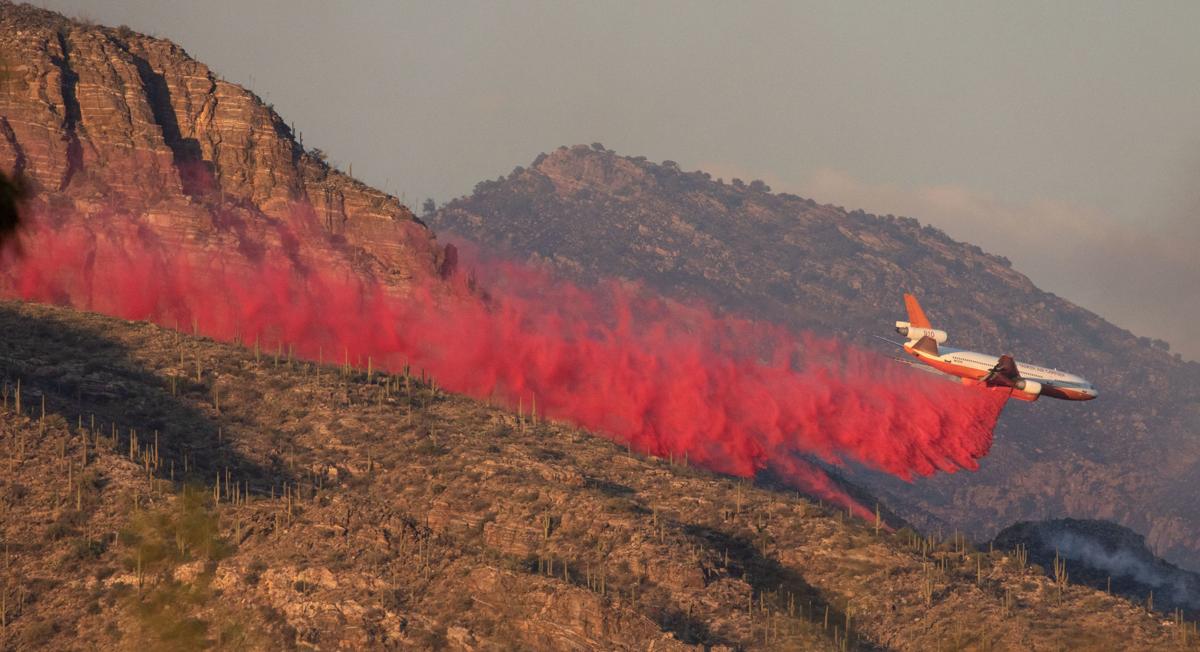
And now they are burning. Less than a week ago, on a Friday night, we could see the flames of the then-much-smaller fire, called the Bighorn Fire because it started on Bighorn Mountain to the west of the view we see from the city. On Saturday, a friend who lives in the northwest close to that area showed me photos and videos of planes – smaller spotter planes and helicopters and huge cargo planes -- piloted by brave pilot firefighters flying within 100 feet of the mountains to drop orange fire retardant. Firefighters and hotshot teams were brought in, but the fire continued to spread, from 200 to 2300 to now 3700 acres [update: passed 7,000 acres, 10% contained]. For a couple of days, planes could not fly, not because of weather but because of a moron flying his own private drones in the area which endangered them. Last night the flames of the original fire looked small as the blaze was now visible across most of the front range, and this morning smoke covers it all. More and more units are being brought in, but it appears as if, unless the summer monsoon rains start soon – and there is no indication that they will – the fire will continue to spread, including down into the canyons like Pima and Finger Rock which are major hiking routes. And it will certainly threaten the houses built up highest in the foothills. Those houses shouldn’t be there, they should never have been built as they are right up to the border of the National Forest (which, fortunately, protects them from being built even higher); one of the more galling hiking experience to Tucsonans for many years now has been that the beautiful Pima Canyon hike begins with a half-mile trek between cyclone fences through a private development. But although they should not be there, the people who live in them should not have to lose their homes and possessions (and of course, we most importantly hope, lives).

When I was in college at Cornell, more than 50 years ago, I was in a dorm fire in which 9 people died. As we escaped that night, the smell of smoke was everywhere, and when I came back to my room it had saturated everything. I still smell that smoke; it was a toxic, petroleum based smoke from burning naugahyde and smells much different from the lovely wood smoke of fireplaces in the winter. But still, at bottom, smoke is smoke, and now as smoke fills the air, threatening to make it more difficult to breathe while outside (and, of course, in this COVID-19 epidemic, N-95 masks have not been available for months, and if they are should go to health workers), the memories are getting more and more vivid.

Bighorn Fire - ArizonaThere have been fires in the Catalinas before. Ten years ago, much of Summerhaven was burned, and the ruined forest is still visible up there. Firefighters have some hope that this fire will become limited as it burns into that already-thinned area. Where the current fires are burning, there has not been fire for a century, and fire is a natural part of the natural cycle. The bighorn sheep on Bighorn Peak and Pusch Ridge that have been re-introduced to supplement a dwindling herd will survive. They can escape the flames. The mountains, eternal as they are, will survive, thinned out. The fire was – this time – started by lightning, not people. But it is people who built so close, and people who will suffer, and our trails will be closed, and the beauty compromised.

And the smell of the smoke will linger.

Roadrunner vs Cooper's hawk: A real life "Discovery Channel" moment!

Amazing things happen in nature, as any viewer of the Discovery channel can attest. I am not personally a viewer of that channel, but have s...