Wednesday, May 15, 2013

TV Westerns without Women

When I was a child in the 1950s (and probably into the early 1960s), there were a lot of “action/adventure” TV shows for children that had only men, no women.  So I guess they were mostly meant for boys. There were a few shows that stood out for featuring strong women (notably, and beloved by my sisters, “Sheena, Queen of the Jungle”, meant to be comparable to Tarzan and certainly a forebear of “Xena, Warrior Princess”. Many of these shows had strong, single men (bachelors or widowers, usually) with a single son, or perhaps ward. “Ward” was an odd term; it had no meaning in our regular lives, but we were familiar with it from DC Comics, as it described similar relationships there (Batman and Robin, of course; also Green Arrow and Speedy and others). It is obvious that there are many implications to these shows regarding gender roles, child rearing, sexual identity, and the role of women; however, I am not going to provide explicit analysis of these themes, which are probably best done by those with scholarly credentials. I am pretty much just going to share memories (with occasional help from Wikipedia for names and dates).

Among these shows were “Fury” (1955-60) with Peter Graves as Jim Newton, and his adopted son Joey, played by Bobby Diamond, “The Rifleman”  (1958-63) with Chuck Connors as Lucas McCain (the kid, Mark played by Johnny Crawford, was, in a rare twist, actually his son), with the adults actually parenting as well as providing role models. Two others that stand out in my memory are “The Adventures of Rin Tin Tin” (1954-59) and “Circus Boy” (1956-58), where the person responsible for the child was the hero, but most of the actual parenting care was done by someone else, an older, lower-status member of the organization. In “Rin Tin Tin” it was Sgt. Biff O’Hara, played by Joe Sawyer, in “Circus Boy”, Joey the clown played by Noah Beery, Jr. These men provided a caretaker role for the boys (both were adopted orphans, Cpl. Rusty, played by Lee Aaker in “RTT”, and Corky, played by future-Monkee Mickey Dolenz, in “Circus Boy”). At the time I perceived this role as “maternal” but in reality was just “parental”, while Lt. Rip Masters and ringmaster Big Tim Champion (what names!), played respectively by James Brown and Robert Lowery performed their handsome, lean-jawed, leader of men activities. The similarity of these two shows was quite obvious to me even as a child; they were carbon copies in different settings.

These men, Sawyer’s O’Hara and Beery’s Joey, were definitely men, both worldly wise and wise in terms of giving advice to the boys worthy of June Cleaver. They  also filled the role of comic-relief sidekick that was a staple of Westerns (movies as well as TV shows), including Andy Devine’s Jingles on “Wild Bill Hickok” (1951-58) opposite Guy Madison, Pat Buttram on “Gene Autry” (1950-56) , Leo Carrillo’s Pancho on “The Cisco Kid” (1950-56) opposite Duncan Reynaldo (in its own twist, notable because Cisco, the hero, carried only one gun while the sidekick, Pancho, carried two!), and Pat Brady in “Roy Rogers” (1951-57). The latter, of course, even had a woman, Roy’s wife Dale Evans who rode her horse, Buttermilk, alongside Roy and Trigger, while Pat followed in his jeep, Nellie Belle. Of course, I always got the Pats, Brady and Buttram, confused.

Obviously, the tradition of stories-for-boys-without-significant-female characters goes far back before these shows, to radio, film and novels well back into the 19th century at least, with swashbuckling heroes. Occasionally, notably in Stevenson’s “Treasure Island”, there is even a boy who is himself at the center of the story, perhaps making these a little more accessible than the similar-but-no-boy classics of Dumas and Sabatini. There may be nothing significant in the trope I noted so long ago of the sidekick-cum-mother, although it appears in the comics, where Alfred the butler plays this role for Batman and Robin.

 And, somewhat later, in “Bonanza” (1959-73), an “adult” TV Western of the 1960s (a group that also included “Maverick”, “Gunsmoke” (with Peter Graves’ brother James Arness), “Have Gun, Will Travel”, “Cimarron”, “Rawhide”, and “Sugarfoot”), Lorne Greene’s Ben Cartwright has three sons (Pernell Roberts’ Adam, Dan Blocker’s Hoss, and Michael Landon’s Little Joe), from three different mothers, all conveniently passed on to both not be present in the show and meet the requisite morality of sequential legal monogamy (each passing before Ben married the next and sired another son). Later the short-lived “Yellow Rose” also had three sons by different mothers (David Soul’s Roy, Edward Albert’s Quisto, and Sam Elliott’s Chance McKenzie), but the patriarch was only married to the mother of Roy. And of course, to Cybill Shepherd’s character, who also had affairs with all of them. There was also a kid, Roy’s son, and humorously Shepherd’s step-grandson. It was, I have to admit despite having had a crush on Shepherd since she was on the cover of “Seventeen”, a pretty bad show that lasted only one season, 1983-84.
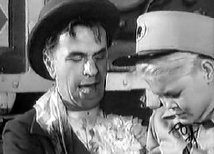
 
OK, enough memories. I could post lots of pictures, but I think I’ll just stick with one. The anomaly, Sheena, Queen of the Jungle. It had its origins in films and pulp novels, and was resurrected more recently, but the one that sticks in mind, and I am sure that of my sisters, is Irish McCalla in the TV show. Oh, and maybe Noah Beery and Mickey Dolenz from Circus Boy.

Friday, January 25, 2013

Les Miserables: not just a good show, but a really important theme


I saw the film Les Misérables recently. I liked it. I acknowledge that it was too long, and that the actors in it were not chosen for their singing voices. I even thought that the opera-style everything-is-sung-even-dialog was ok. I suppose I would have been less surprised by the latter, and maybe even more intolerant of the former (the singing) had I been one of the 60 million or so people who had seen the musical on stage, but I was not. I was familiar with the story, though I am certain I never read the entire 1500 pages (Cliff’s Notes, maybe? or "Classics Comics"?), and I had seen previous film versions.

My favorite is the one with Jean-Paul Belmondo, updated to take place in WW II, from 1995. I have always like Belmondo, but tended to think of him as the lean hero of his youth; to see him as the big, handsome older man in his 60s (he was born in 1933) was great. And it seemed more plausible that he was able to lift the cart off the trapped man than Hugh Jackman, even though Belmondo was much closer to what Jean Valjean’s actual age would have been. 

The reason that updating the Belmondo film to WW II was fine was the same reason I liked the recent movie: that the social and political issues it addresses are timeless. Les Misérables, book, musical or film, is not about the music but about the oppression of people – mainly poor people – by the rich and powerful and their minions. It is a profoundly political movie, and to see it and to not understand that would be, well, something I don’t understand. It is not just about the nobility and heroism of one man, who was imprisoned for 19 years for stealing a loaf of bread to feed his starving nephew and then becomes reborn and redeemed (did he have to be redeemed?) by a kindly monsignor, and his future works, which included sparing the life of his life-long adversary Javert when he had the chance to kill him. 

It is not about religion. It is about the ever-present possibility of the people rising up to free themselves of the yoke of tyranny as much as the tyrants continue to be able to continue to return to power. When Anatole France wrote in “The Red Lily” in 1894 that “The law, in its majestic equality, forbids the rich as well as the poor to sleep under bridges, to beg in the streets, and to steal bread,” he is both thinking of Hugo and commenting on profound injustice of the social order. Les Misérables takes place between 1815 and 1832. The French Revolution has come, and gone, as has Napoleon, but there is still a monarchy, and an aristocracy, and brutal oppression of the poor and repression of those who rise against the powerful.

Kind of like today. When banks are too big to fail, when millions of Americans have lost their jobs and homes and the banks like JP Morgan Chase, bailed out by our taxes, records a record profit of $21 billion, and their CEO is proud of it when he should be in prison. When corporations seek to be judged solely on how much profit they make, rather than whether in doing so it makes the world a better place. In America, we support capitalism and for-profit corporations, but we should not be supporting rapacious profit making, profit making that depends on destroying so many people’s lives. 

In Kansas, Governor Sam Brownback proposes to make up the enormous budget deficit caused by the tax cuts he pushed through last year by “growing the economy”. This is dubious and uncertain enough in itself, but this is also his solution to meeting the health needs of the people he will not expand Medicaid to cover: they will get jobs. Except that the kind of jobs they get don’t usually come with health insurance, and Brownback would be the last person to require them to do so. The goal should not be to grow the economy so that some people can make most of the money, it should be to grow the economy to be able to make people’s lives better.  In my “Medicine and Social Justice” blog from November 3, I quoted Greek physician Alex Benos saying ““Health and health care are not commodities that exist to drive the economy. They are among the social goals which we have an economy to achieve.”

The catchphrase of the French Revolution was “Liberté, Égalité, Fraternité -- Liberty-Equality-Fraternity. I recently purchased a roll of stamps, and the familiar flag stamp has had added to it “Freedom, Equality, Justice (each on every third stamp). The difference in the third one is instructive. Justice is good, and is important, and certainly was absent in France both before their revolution of 1789 and in the years depicted in Les Misérables. Sure, in the US we don’t say “fraternity” in this context, but there could be a similar word, like “brotherhood”. But it is not the word, it is the concept. It is the concept of social responsibility, of caring about others, about a “we are in this together” attitude that does not characterize American society. If it did, we would not tolerate people being without access to health care, or civilians carrying assault weapons, or ever increasing percentages of our national wealth being in the hands of the top <1%.


In the Hooper film, the final scene is after Valjean’s death. There has been a lot of church in the movie; in addition to the good monsignor who tells the police that he has gifted Valjean with the silver he has stolen, creating the transformation of Valjean from an amoral victim to a hero, later he and his “daughter”, Cozette, are hidden from the police in a convent. He dies in a church, with Cozette’s dead mother, Fantine, coming for him in a most mystical way. A lot of church and a lot of religion. And yet, that final scene does not show Valjean in a heaven of clouds, harps and angels with wings. The heaven he goes to is the revolution, all the people who have died in the movie and hundreds more massed on an enormous barricade, many more than were in the actual battle in the film. They are there, they are militant, and though they have been beaten are singing about liberty.

The fight will not be easy, the oppressor has many weapons on his side, you may be killed in the battle, but it is the good fight, the fight for what is right. This is the true message of Les Misérables.

Monday, December 17, 2012

It's too cold for you in Santa Fe! You'd hate it!


It’s cold out here southeast of Santa Fe, much colder than in Kansas City. Or, for that matter, Wichita, Liberal, Guymon, Dalhart or even Tucumcari, all of which towns I drove through, accompanied by Yonkel and Fry (neither of whom, it turns out, drive). There is snow on the ground from snows a couple of days ago, and the last leg of the trip, 40 miles up US 285 from I-40, was somewhat slowed by blowing and drifting snow (hey, the Galisteo Basin is a BASIN, flat, like high plains). Temperatures at night are in the teens, and in the 30s in the day. And it supposed to snow some more tomorrow or the next day. So stay in your nice balmy places further south or at lower elevation. You probably wouldn’t like it here.

On the other hand, there is the incredibly beautiful thing. I see great expanses of conifers (mostly juniper, but the piñons are beginning to return) white expanses, mountains in the (not too far off distance). And, of course, since we are not in Santa Fe, and you are frolicking in the warm weather, not a person around. I did drive to Eldorado for gas and groceries yesterday, but certainly not all the way (15 minutes) to Santa Fe, and today and probably tomorrow will stay here. I’ll go into town when Pat and the others get here, closer to Christmas.

We went for a lovely walk this morning through the snow, to the “back 40” (OK, it’s not 40, but it’s enough) to see the views over the Galisteo Basin. Fry is loving it; good old Yonkel stays closer to be near me. The black canvas duster with the sheepskin lining that Pat hates turns out to be perfect for keeping the wind out (oh, yeah, there’s wind too. Stay in Memphis). As long as your feet, head and ears are covered, the walk is great. Yonkel is barking at something I cannot see outside, but not too much last night. It was a “2 dog night” and they didn’t get up much.

I did, though. I opened my eyes around midnight and the eastern sky was full of stars. Got a little dressed and went out on the deck; no clouds in that direction, and so many stars I could barely find Orion in the middle of it all; most of the time, even down at the lake (and certainly in KC) that is all you can find. Among them, some planets, probably changing through the night. Straight east the Dog Star, Sirius, shining on my dogs, and right above the bright star Aldebaran from Taurus (they would have barked at that). This morning Sirius is replaced by the Morning Star, Venus. I couldn’t, of course, take pictures of the stars at night – it’s only a cell phone! – so I will share a couple of others, of the sunrise this morning, and of the reflected sunset on the Sangre de Cristo mountains to the northeast last night. I can’t write for long; the sun will soon be streaming into the “darkest” part of the house; the computer has been unusable in the main room since 7 am. It may be cold, but the sun is shining bright!

I guess I’ll just have to put on my cross-country skis and go see how the skiing is along the road. And then maybe it will be time for a nap.


Enjoy the warm weather!

Sunday, November 18, 2012

Fry dog: too smart for his own good!


So Pat just drove down to Santa Fe with the dog. It was going to be the dogs, and indeed started with the dogs, for oh, about 2 miles. To the gas station just west of the 18th Street Trafficway on Steele Road. Then she opened the back and Fry jumped out and ran off. He likes to do that; he’s part beagle. He is an escape artist; just let him in the back yard and he’ll find just where there is enough space between fence and ground to wriggle out. That’s the advantage of the small head; even if Yonkel had the motivation or smarts, he wouldn’t make it. Fry is smart enough to know when he can’t get out; he is fine lying around on the couch all day if he is in the house; he doesn’t get anxious the way that Yonkel does. Which is not to say he doesn’t ever get antsy or walk around in circles; he does. And, of course, if tied up outside he barks at everything. He is, after all, part beagle. But, unlike Yonkel, he has never chewed through his leash. Or chewed up the fender and mudflap of my car.

Anyway, there have been a number of episodes where Fry has gotten away and not come back for a long time. Several years back, I chased him up and down our street, and all the little dead end side streets. For an hour. Then I gave up as I was late for work. That afternoon I came back and he was in the building; someone had let him in. And there was the time at the lake, with Adam, where it was about a half-hour of chasing him around. And a few other times. So, at the gas station, there he is, wandering around, looking at Pat, and running away having a gay old time, playing.

And then, after an hour, Pat and Yonkel left. For Santa Fe. Goodbye, Fry, tagged and chipped hopefully someone will find you and call. I was stuck at work so it was several hours later and dark when I got home, half expecting to find him there – it is only a couple of miles. But no. So I drive to the gas station. And there, in the dark, lurking around the pumps, is the Fry dog.

I stop the car, and get out. He looks up and recognizes it, and comes back around the back. He is unsure of himself, if he is in trouble. I invite him in, and drive back home. He drinks a bunch of water, and I feed him dinner and he sleeps a while on the couch; we go for a short walk later. He is chastened, a little, maybe, for a while. Perhaps. In any case, he is out of a trip to New Mexico, and playing around in the desert for a week; I am flying and he is going to go stay with friends (if he is lucky) or a kennel.

But that is several days away. Now he is with me, wondering where Yonkel is. Pat goes away sometimes, but Yonkel and he are always together. Pat assures me, from Santa Fe, that Yonkel has no such stress; he is fine without Fry. So, today we drove down to the lake. And he recognizes it, and is happy, and is waiting not too peacefully for our walk. And so we walk.

Along the road that we always walk, down the west side of the lake from the little road to our house to the public dock. I let him off the leash, despite the new and (to me) ominous signs about every hundred feet on right on the other side of the road that said “WIHA. Walk in Hunting Area only. Shotguns and Bows only. No Fireams Deer Hunting”. Somehow, I was not reassured, but I didn’t hear any shooting or zings of arrows. I guess it is ok to hunt deer with bows, which is a good thing; for birds you need a shotgun, and I don’t think you’re going to hunt rabbits with a bow, unless you’re Catnip Everlast from the “Hunger Games”; even Robin Hood stuck pretty much to deer!

But I let him off the leash anyway, and he seemed to walk closer to me than usual. At least for a while. He didn’t really disappear from sight, not for very long, for the walk down to the dock. We did have a little issue as we passed the house at the next road, where there is a big dog that is protective, barks a lot, and has been even known to come out to chase and attack our dogs. He was there, and alerted by a new dog, a smaller dog, probably a cocker spaniel, whose job, it appeared, was to bark and alert the bigger dog. So out they came, and I am warning them back while urging Fry to move quickly on. And Fry needs to stop and pee on the tree right on their lawn. He must feel safe when I’m there, but they were still threatening and I kept warning them back and urging him on, and he felt he needed to stop and pee again. And now the lady of the house is out calling her dogs back, and I’m still warning them off and urging Fry on, so now he decides, of course, to make one more stop at the edge of their property to pee once more.

A smart dog, but not one with very mature judgment. Oh, well. Maybe he’ll enjoy being gone from us all for a week. It looks like he is going to have the opportunity to hang with some other dogs on a lot of land, and maybe even be tested on another beagle characteristic, hunting (or at least finding birds that have been planted).

This morning we went on another walk, following the beautiful sunrise. (OK, following by an hour and a half; I had to wake up, dress, make and drink coffee, eat breakfast – all those irrititating dog-walk-delaying things people do! Cooler, and a lovely walk; I really like it down here. Of course, Fry left less than halfway to the dam, and I worried as I continued to watch the WIHA signs and even heard a shot. I was wearing my RED jacket! He joined me again just before the same house; no dogs out today so he was even bolder, marking on the ground by their sign and thoroughly exploring (and I imagine marking more) their yard; I was on my way home. There is, in any case, a ritualistic nature to our walks; he will not leave our area to go up the hill unless I accompany him (which I only do a couple of times a day, despite his persistent hints, running a ways up the hill and looking back), but once on the road, he is on his own, and comes back on his own.

Now he is lying on the futon in the sun, and I am having another cuppa. J

Sunday, September 23, 2012

Dogs, the lake and hunting


So we hear that the city and county have decided to allow hunting around our lake. But take heart: they have decided to not allow rifles, only bow and shotgun! Phew! Of course, they are allowing it right up to the road, which I walk the dogs on all the way down to the public dock. But today I hear that it is being done because the state of Kansas is paying them to do it. The state is broke, and cutting back on education, health care, senior services and everything else, but it has money to pay localities to encourage hunting! There’s something completely incomprehensible about that.

So yesterday, I walk the dogs in the morning as usual. I hope that their color of tan is not too much like a deer, but it is early on Saturday, and quiet. Amazing. No sounds of gasoline engines from cars, boats, planes, or lawn mowers yet. The walk passes without incident. Well, almost without incident. Fry, as usual, is off doing his thing. Every once in a while he comes back to check. We find our way to the camping/picnic area, and run into a lady with two mini dachshunds. Dachshunds are small with short legs, mini dachshunds are smaller, and these two were chub-balls so their bellies almost touched the ground. She was pleased to know that the dog down by the lake (Fry) was mine; Yonkel, she noted approvingly, stayed by me.

On the way back, though, in the woods around which the first housing road circles, Fry spied something and charged in. Yonkel, weighing prudence against excitement, hesitated a couple of moments and then followed. Not to be heard from for quite a while. I came home dog-less. After maybe 45 minutes I went out in the car, down to the public dock, and then back on that first road. There is Yonkel. He gladly gets in as I open the back of the car. A little farther on is Fry. He won’t get in, but is willing to trot alongside the car. I get tired of going so slowly, so leave him. He is back after another 45 minutes or so. OK.

This morning, we went out a little later, after 9:30am. By 10, they were both gone again, in the same woods, and I had kept walking and realized that they were not coming, so I headed home. They weren’t there. I sat down, worked for a while, worried about hunters. After about 45 minutes I went out in the car and re-drove yesterday’s routes. No luck. No dogs. No sound. Drove some more. Came back home. No dogs. Worked some more.

About 11:40, I get a call. One of my dogs had been stuck in the water and couldn’t get out, but this woman’s husband and another man pulled him out. Wow, am I grateful! I was wondering why at least Yonkel hadn’t returned! I quickly drive over there, to the first road. No dogs, but the two very nice men who had pulled them out are there; they say the one fell off the dock, they guessed. They have just headed off, generally in the direction of my house. I thank them and head home. No dogs. No dogs for a long time. I go back out and drive.

I go back to the same place, and the same two guys are still there. I just missed them, they say, they had headed out in the other direction. The older guy who lives there had heard the barking, and thought it was across the inlet at the picnic area. Then he looked down and saw the dog stuck in the water. It’s hard for him (the man) to get down the hill, so this other guy helps (not so young himself). He says that the other dog was sitting on the dock watching. I choose to believe that Fry was loyally staying by his friend. The one he had gotten in trouble in the first place.

I figure NOW they must be headed home; I can’t believe that at least Yonkel hasn’t had enough. But I go the other way to the public dock first to make sure, then come home. No dogs.

Finally, as the clock chimes 1pm, there is a scratching at the door, and there is a very wet Yonkel outside. Too wet, in fact, for this to have been from that episode over almost 2 hours ago. Incredibly, he must have been back in the water! How dumb can he get?

So I towel him down before bringing him in and putting him by the space heater, where he starts on the long process of licking himself off.  Now he is asleep. And still no sign of Fry yet. I figure he’ll get hungry after a while. In 2 or 3 hours. Oh, here he is! Couldn’t actually post the piece until he showed up (1:30)

And I was worried about them getting shot! They can get themselves into enough trouble without help!

Sunday, August 19, 2012

Cooler summer days at the lake


Summer has cooled off in Kansas; after the hottest July ever, with very few days under 100, we had a lovely weekend last week at the lake. On Saturday, the high was in the 80s, with little breeze. Saturday morning I went kayaking. I wasn’t sure if I would go all the way down to the streams that feed the lake, especially after passing through the gnat-covered surface on the biggest, widest part. But I did, and saw a lot of wildlife, including an otter. I was just turning into the feeder, when I saw something swimming to my left; at first I thought it was a turtle, but it swam for too long without going under. Then it turned left in front of the kayak and I almost ran over it until “slap” went its tail, and it went under.

Along with the heat has come drought, and the lake is several feet down, even lower this weekend than last. This has some good features for seeing wildlife in the morning, as the birds and animals can come further down, onto more exposed mudflats. On my kayaking this morning, for example, I saw a great blue heron in the middle of the lower (shallower) part of the lake, standing on a branch sticking up out of the water.

No gnats covering the surface this morning (by the way, they were gone on my return last week), but, in addition to a couple of barking dogs, someone a ways down thought mowing his lawn at 6:30am was a good idea; I was only a little bothered, but I’m glad I am not one of his neighbors trying to sleep in on a Saturday. So I pressed on, and as I passed the first cove to the right beyond him, I saw movement on the shore, maybe a deer. I slowly and quietly paddled in, and saw it, and the other one I had dismissed as a stick from farther away. And the great blue heron on a rock on my left, which flew off as I turned. (not my pictures! I’m not taking a camera out in the kayak!)
 
So I stayed close to the west shore where there are stretches with no houses because the road runs right by the lake; however, at that time of morning no cars to disturb things. Near the shore I saw the swimming I now knew as an otter, and paddled toward it. Rather than diving under water, it climbed up on a rock near the shore, giving me a great view of it! Then, down a bit, I saw another great blue a little ways off, and then a smaller bird on the rocks very near me – a green heron. It, unlike, the great blues, was not fazed by my presence.

And I continued south, still not sure how far I’d go, but continuing to see great blues (like the one on the log in the middle of the lake) and then, as I approached the end where the stream comes in I saw what first looked like two herons on the shore, then more, then more. I quietly approached, and more and more came out of the woods, until, as I got quite close, a flock of more than a dozen wild turkeys were on the mud flat.

That’s a lot to see in one kayak trip so I turned back toward home. But there, on the shore, near me, fully visible, another deer. And along a ways, paddling near one of the spits of land built out of rocks piled there for fishing, I again came within feet of the green heron (or its brother).  Then, more quickly toward home, ignoring the more great blues, but, as I approached the last point I saw “our” osprey soar overhead for the first time this year.

I left the kayak and walked to the house and the coffee I had set up to brew. And swimming by came three white geese with orange “bulbs” at the base of their bills. Not sure what species; if the bulb had been black, they’d look like swans.


In the house with my coffee. And my dogs. And Pat, still asleep.

Wednesday, August 8, 2012

Kansas Government has become yet more conservative

I know that there are not many people who consider themselves conservatives who read this blog. Largely, this is because there are not very many people who read this blog altogether. So nothing I say is going to surprise anyone, nor is it likely to change any minds. Still…
I moved to Kansas in 2002. I knew it was a conservative, Republican state. While I’d grown up in New York and lived much of my adult life in Chicago, I’d spent a number of years in Texas before coming here, so it wasn’t as if I was unused to conservative, Republican states. I also knew that there were a lot of good, hard-working, progressive people in Texas and there were certain to be those in Kansas, particularly in the Kansas City area. In Texas I lived in San Antonio, a Democratic city with a series of Democratic mayors, many of whom were progressive young Latinos like Henry Cisneros (before my time), Ed Garza, and now the dynamic leader Julián Castro. While the Governors, since Ann Richards, and Senators, since Lloyd Bentsen, were Republicans, my Congressman, who live in my neighborhood, was the venerable Henry Gonzáles, followed after he died by his son Charlie. While there were conservative  Congressmen from the area, Gonzáles was not the only progressive; Ciro Rodríguez maybe was more so.
And my state legislators made me proud. Also Latinos and Latinas, mostly young, they were unafraid to take on the big issues. In 2003, shortly after I left, Democratic members of both the Texas House and Senate left the state to try to block a redistricting plan that would favor Republicans. In each house, they were led by the people who represented my district, Leticia van de Putte in the Senate and Mike Villarreal in the House. While Texas as a whole has continued to move so far to the right that Governor Rick Perry’s pick to succeed him was defeated by a Tea Party candidate, and the Republican state platform calls for an end to the teaching of “critical thinking” in the public schools, good things continue to happen in San Antonio. When the Arizona Department of Education recently closed down the Tucson Unified School District’s Hispanic Studies program (Tucson is another place I’ve lived, a relatively progressive part of a very conservative state), it banned the poetry of Carmen Tafolla. Mayor Castro named Ms. Tafolla the first Poet Laureate of San Antonio. His brother, Joaquín Castro is running for Congress. The state representative from the district next to mine, Trey Martínez Fisher, is leader of the Democratic opposition in the state house.
When I moved to Kansas, I chose to live in Kansas City, KS. The “other side of the tracks”, it was not only near work, it was not the suburbs where most of my colleagues lived. In Johnson County, the wealthy county to the south of “KCK”’s Wyandotte County, everyone had to register Republican to have a say in the election. Wyandotte was, and still is, one of only two Democratic counties in the state (the other being Douglas, where Lawrence, home of the University of Kansas, is located). We even had a Democratic congressman, Dennis Moore. A “blue dog” Democrat, yes; he was from Johnson County, but at least not breaking my until-recently string of never living in a congressional district represented by a Republican. In 2010 Moore retired, and was replaced by a conservative Republican.
When I first voted in Kansas, in 2002, I was shocked to find that there was no one running against then-and-now incumbent senator Pat Roberts. Knowing little about Sen. Roberts but strongly favoring the democracy that requires contested elections, I wrote in the name of a colleague. In 2002, Kansas was pretty conservative. It was led by Republicans, but had a history of support for core government functions such as education. The legislature was about 1/3 Democratic, 1/3 moderate Republican, and 1/3 “conservative” Republican. When I visited the Capitol the morning after the end of the longest-running legislative session to date as part of a KU-sponsored tour, we were addressed by a panel of commentators. One was the Lieutenant Governor, a “moderate” Republican, who, obviously exhausted, was strongly critical of the right wing of his party. Yes, he called them “the black helicopter crowd”. He noted that “moderate” were moderate because sometimes they liked to do things like go to their kids baseball games, or fish or hunt or do something besides “plotting in basements”.
Things have not gotten better. While that year we elected a Democratic governor, Kathleen Sebelius (Kansas had a history of electing a Democrat every 3-4 governors, while never ever turning over control of the legislature), the legislature became more conservative. Thomas Frank published his popular book “What’s the Matter with Kansas?” in 2004 while Sebelius was still governor giving his perspective on the rightward turn of the state, which included the replacement of long-time liberal, Jewish Congressman Dan Glickman from Wichita, named by President Clinton to be Secretary of Agriculture, by a string of very conservative congressmen. It has become much more so now. Conservatives replaced moderates as Speaker of the House, and later were replaced by more conservative challengers. In 2010, Sam Brownback, the very conservative US Senator and former Presidential candidate, was elected governor. The House strongly supported his agenda, but the Senate, in a coalition of moderate Republicans and Democrats, blocked several initiatives. With his support, and the support of lots of money from Kansas Chamber of Commerce and the Koch brothers’ (they are from Wichita) funded group Americans for Prosperity (indeed, much of the COC money comes from AFP), conservatives ran against virtually every moderate Republican incumbent in the Senate.
The primary was yesterday, and it looks like most of them won. They only needed 3-4 Senate seats and got a lot more (presuming, of course, that the winners from yesterday are not beaten by Democrats in the general election, a pretty safe assumption). Even the long-time Senate President, rancher Steve Morris of Hugoton in the far SW corner of the state, looks like he is headed to defeat. Governor Brownback, the COC and the Koch brothers win. Health care and education, the two big items on the state budget, look like they will lose. Republicans sometimes accuse Democrats of “never having met a tax they didn’t like”; in Kansas this is untrue, but that the current Republican majority never met a tax cut they didn’t like is true. No matter how Draconian. After years of recession and state budget cuts stemming from inadequate revenue, projections were for a rise this year. The governor proposed, and the legislature passed new big tax cuts, especially (surprise!) for the wealthy. (The Senate also; word is that they thought they were “calling the House’s bluff”, but wrong. No bluff!) So this year’s and next year’s cuts in education and Medicaid funding will be even worse. And, of course, the Governor will not take federal money for Medicaid.
Why? Part of it is probably the trend that Thomas Franks pointed out is true and Kansans are getting more conservative (although at this point, the group elected are not “conserving” anything; they are simply destroying). A lot of it is likely that the big money contributions are effecting voters through their dominance of the voters’ main source of information, TV (and make no mistake; despite the media’s efforts to portray contributions by unions to the moderates as balancing, the funding from AFP and COC and others for the conservatives was several times higher). And a lot of it is that there are not many people voting, probably less than 20% in this primary according to Kansas Secretary of State Kris Kobach (himself an arch “conservative”, author of the Arizona immigration law). Voter turnout in this country is low, turnout in primaries is lower, and turnout among more “Democratic” constituencies such as the poor and minorities is lower still. The efforts to disenfranchise these folks by techniques such as photo-ID requirements (falsely sold as a counter to the non-problem of voter fraud) and decreasing the number of polling places (from having less state money) are likely to increase the problem.
I admit I didn’t vote; as a Democrat in Wyandotte County there were no races being contested for me. But I still usually would make a symbolic appearance, and this year, with no Democratic candidate running in the primary for Congress to oppose the Republican incumbent, I could have, as in 2002, written in my colleague. But my polling place, moved from the church down the street to farther-away-but-still-on-the-way-to-work a few years ago, has now moved a couple of miles in the opposite direction. I have a car, and even after a long workday would have definitely gone if there was any chance that my vote would have mattered. But a lot of folks don’t have cars or ways to get to the polls, or photo ID for that matter, and these are major obstacles to a large voter turnout.
I believe in democracy. If the majority of people want to vote for folks I disagree with, that is their right, even if it is not in their interests. It is too bad if they are convinced to do so by misleading-to-lying attack ads funded by billionaires. But efforts to restrict voting by any means, ID, or fewer polling places, or making it more difficult to register, or not having advance voting, is absolutely wrong.
Back in San Antonio, there was advance voting, and we could vote at the supermarket weeks before Election Day. Anything that gets more people to the polls is good, and a true expression of our democracy.

More on Dogs: Navigating other dogs

Running into other dogs on a dog walk is a crap shoot. I am pretty unable to tell which dogs will cause my dogs to react, or which other dog...